The Times Interview
This man could save your marriage
After 40 years as a psychoanalyst, Stephen Grosz knows a thing or two about what makes a successful relationship. The Examined Life author talks commitment, parenting and love in the age of internet dating
(Charlotte Ivers, The Times)
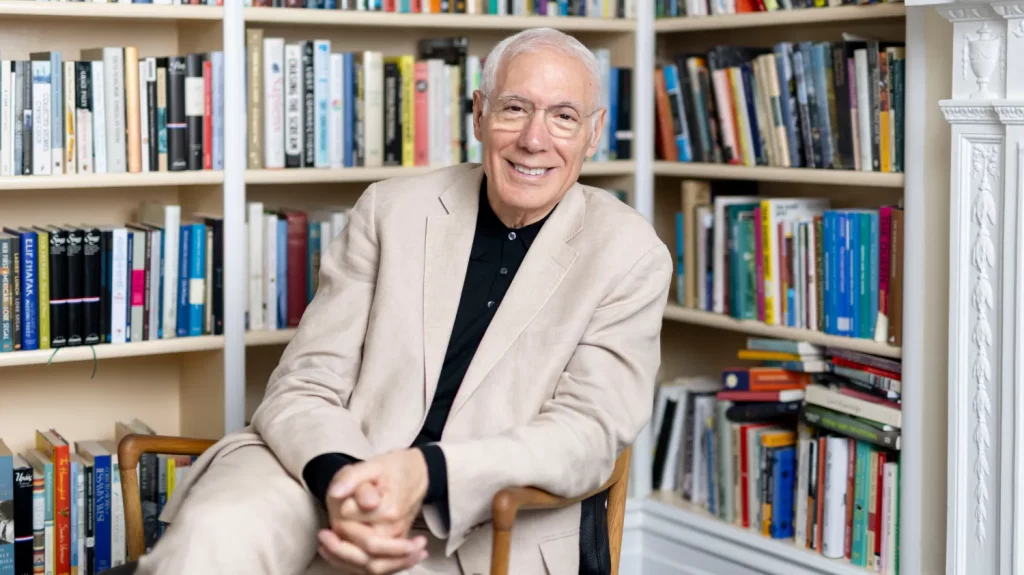
Stephen Grosz did not expect to be having this conversation. When he published The Examined Life: How We Lose and Find Ourselves in 2014 he thought it would just end up in specialist psychology bookshops. He calls it “this old thing on the shelf”. Instead the book became a Sunday Times No 1 bestseller and was translated into 30 languages. “I was really surprised,” he says.
He shouldn’t have been. Grosz’s book, a collection of stories relayed and lessons learnt after 25 years speaking to patients, scratched that most fundamental of human itches: the desire to know what is going on in other people’s heads. Since The Examined Life, psychology books have been a mainstay of the bestseller charts, spreading to television and podcasts with shows such as the BBC series Couples Therapy and the podcast Where Should We Begin? with the psychotherapist Esther Perel.
Now aged 72 and more than a decade since his debut, Grosz has written Love’s Labour, sating perhaps an even more fundamental human urge: our desire to know what is going on in other people’s bedrooms.
Love’s Labour follows a similar format to The Examined Life: a series of vignettes from his meetings with patients. A woman who loves her fiancé deeply can’t bring herself to send her half of the invitations for their wedding. A troubled young man is unable to forgive himself for the suicide of his girlfriend. A man leaves his wife for another woman and when that other woman dies he holds his ex-wife’s hand at the funeral for comfort. From these stories Grosz hopes to share “hard-won truths that my patients and I won together”.
We meet in Grosz’s treatment room on the ground floor of the beautiful terraced house in Hampstead, north London, that he shares with his wife, Nicola, an academic and translator, and his two children, a daughter, aged 22, and a 19-year-old son. “They will abide by no psychoanalysis upstairs. In fact, if one of my children has a dream they will usually turn to my wife,” he says with a laugh.
The place is a picture-perfect representation of what you imagine a psychoanalyst’s office to be: walls lined with books, a big bay window, a couch. Grosz is similarly perfectly cast: tall, with neat white hair and a calm voice, the slightest of American lilts still present from his upbringing in Indiana and university years at Berkeley, California.
“I have to sit there,” he gestures to his analyst’s chair, “otherwise this will feel odd.” If I were his analyst perhaps I’d recognise an anxiety in him — the man who asks questions now has to face questions. That’s part of the appeal of Grosz’s books: he makes you feel as if you can do this too. “This” is psychoanalysis, a therapeutic technique pioneered by Sigmund Freud that seeks to draw out the patient’s unconscious thoughts and get to the source of their distress.
A key part of this is the interpretation of dreams — something that comes up frequently in Grosz’s books. “I’m aware that most of the people who read this book will not have had analysis, so part of it was trying to convey what the experience is like,” he says.
Take the woman in Love’s Labour who visits Grosz because she is unable to send out wedding invitations. She arrives with a dream that she is uncomfortable relaying. While she is not Jewish (Grosz is), she dreamt the night before that she was herded into a changing room, promised a shower and instead found herself in a gas chamber.
The two mull over what this dream might mean. They eventually come to realise it “is not about Nazis or Jews”, Grosz says. Instead the changing room represents his office: a room where people change. The dream is a manifestation of “her anxiety about her terrible loss of her birth family if she marries her husband. She doesn’t want to give up what she has. She wants the new thing — to marry this guy — but she doesn’t want to lose her parents and she sees sending out the invitations as annihilating the family.”
“The dream is a kind of doorway in. I often see them like a movie that the patient has written, directed, produced and starred in. It’s a pure internal creation of ourselves. Today people are so focused externally that they are not thinking about their dreams, they are not thinking about their daydreams — fantasies just pass through their mind for the most part. In therapy dreams are a good way of showing a person to be more alert to their internal world and their feelings.”