Dishcast with Andrew Sullivan
Stephen Grosz talks to Andrew Sullivan about Love And Psychoanalysis on “The Weekly Dish”

.
Stephen Grosz talks to Andrew Sullivan about Love And Psychoanalysis on “The Weekly Dish”
.
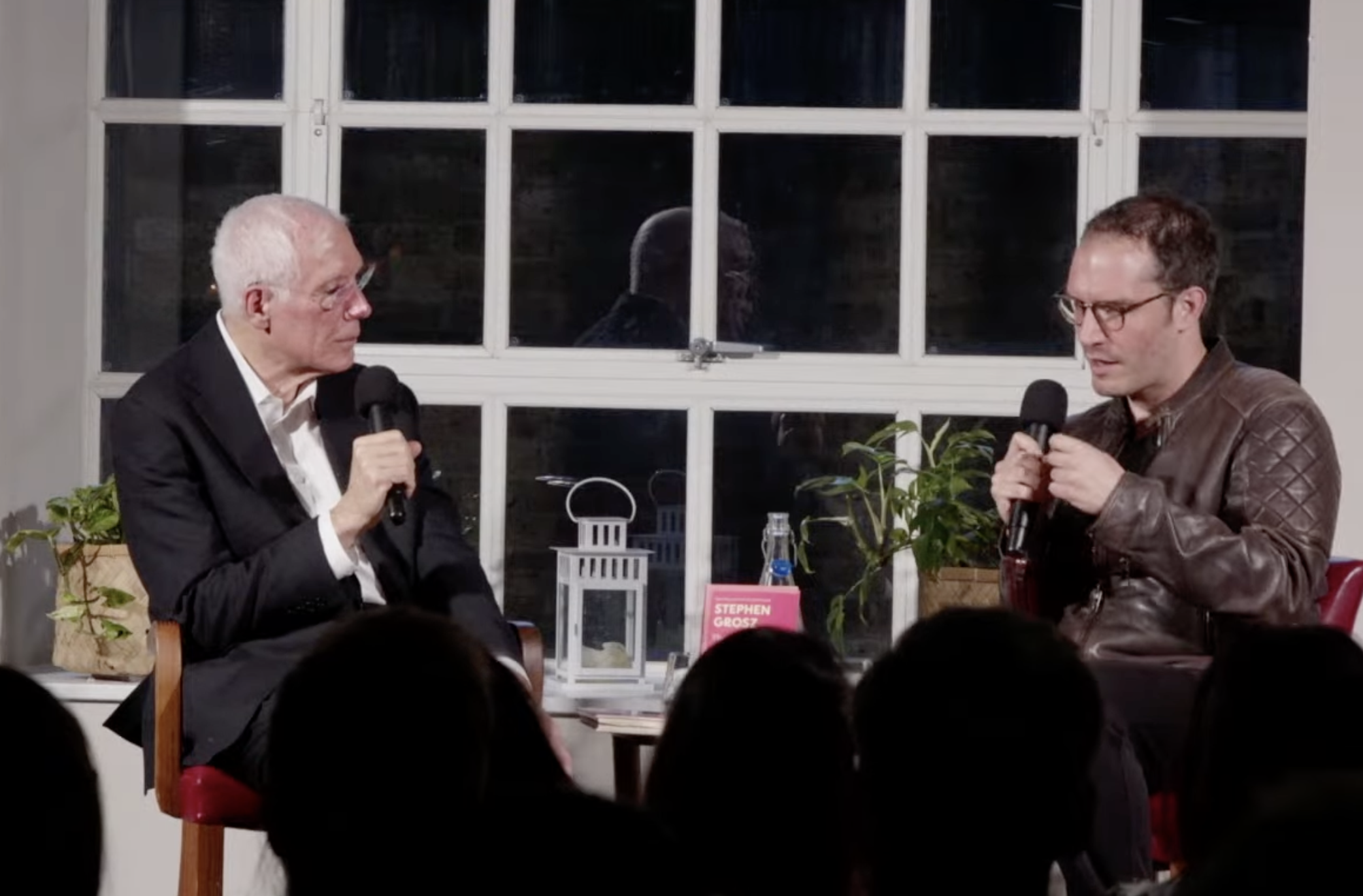
Rodrigo Barahona talks to Stephen Grosz
For the Quarterly’s upcoming October 2026 issue, our Book Review Editor Rodrigo Barahona interviewed writer and analyst Stephen Grosz about his newest book Love’s Labor: How We Break and Make the Bonds of Love. The Quarterly will publish a review of Stephen’s book written by Sarah Ackerman in October 2026.
By Daphne Merkin
March 3, 2026

To many of us, what goes on in analysis or psychotherapy remains a well-guarded mystery, and its practitioners mythical creatures, bearers of special wisdom — or, if we are skeptical enough about the profession’s effectiveness, like Wizards of Oz behind the curtain. In his new book, “Love’s Labor,” Stephen Grosz, an American-born psychoanalyst who has practiced in London since 1987, breaks the spell by taking us directly into the sanctum sanctorum, otherwise known as the analyst’s office.
One of the most gripping, curvy stories in the book, which comprises 12 case studies about love and intimacy (all of which, to a greater or lesser degree, are fictionalized), is called “Connections.” It involves two married couples, three members of whom are psychoanalysts from New York and close friends. Grosz, then in his early 40s and unmarried, first meets them at a conference of American and European analysts in Cork, Ireland, and continues to see them over the next six years at other meetings. Both couples are “appealing people” who seem content in their lives, until it suddenly emerges at a meeting in Glasgow that one of the women, Cora, is sleeping with the husband of the other woman, Susan.
This development leads to an all-out confrontation between the two women at a cafe. Susan calls Cora a “sociopath” and accuses her of not understanding what being a psychoanalyst is about: “Mending. Repairing. Having empathy. Caring for others. Respecting boundaries.” Cora hits back: “You don’t sound like a psychoanalyst. You sound like some old rabbi.” And she insists that the true aim of psychoanalysis is allowing a person to acknowledge their real desires, however difficult or inconvenient, so that they can live more freely and truthfully. As Cora pleads with her to understand things from her perspective, Susan slaps down some money and walks away.
Both women confide in Grosz the details of the fight, and a year later his friends’ furious disagreement about the purpose of psychoanalysis still disturbs him, so much so that he is prompted to try to refine his own definition of it. He makes a list of different ideas that have struck him from his reading and training, among them: to make what is unconscious conscious (Freud); to break the spell of self-deception (Amadeo Limentani); to tolerate ambivalent feelings and experience the world with less fear and fragmentation (Melanie Klein); to wrest knowledge from suffering (Jonathan Lear).
None of these are fully satisfying: Grosz finds himself questioning the very notion of an “aim” in psychoanalysis. It seems to him that insisting upon one is “an intrusion on the patient’s autonomy — an attack on the power to identify one’s own desires, decide one’s own mind.” In the end, the friendship between Grosz and the two couples fizzles out, but what lingers is his respect for both Susan’s and Cora’s points of view and curiosity about how psychoanalysis might help them bear their rage, disappointment and colliding needs.
This vignette, and the circling approach to its subject, coming in close and lifting off for a more aerial view, is typical of Grosz. His capacity for self-interrogation, and for constantly turning over in his mind what the role of an analyst should be, characterizes all of the case studies in “Love’s Labor.” Grosz, who is 73, first became well known to readers in 2013 when he published “The Examined Life: How We Lose and Find Ourselves.” Based on 25 years of his work with patients, the book, a collection of 31 case studies, became a critically acclaimed best seller in England and went on to sell nearly half a million copies worldwide, as well as being translated into more than 30 languages.
Ayesha Rascoe talks with psychoanalyst Stephen Grosz about his new book, “Love’s Labor: How We Break and Make the Bonds of Love.”

Why is love so difficult? Why do we push it away, sabotage it, or cling to it long after it’s gone? Drawing on over forty years of conversations with patients, renowned psychoanalyst and author Stephen Grosz invites us into the intimate space of the consulting room to explore what gets in the way of falling—and staying—in love.
Here he is in conversation with Robert Icke at The Conduit for a searching, deeply human conversation on the mysteries of the heart—and the lifelong work of loving and being loved.
 Love is going to hurt: Stephen talks to Elizabeth Day of “How to Fail” about his most recent book “Love’s Labour”
Stephen Grosz is a practising psychoanalyst and a personal hero of mine. He has worked with patients for more than 45 years and his first book, The Examined Life, drew on these experiences. When it was published in 2013, it caused a sensation and went straight to number one in the Sunday Times bestseller list. Since then, hundreds of thousands of readers, including me, have taken it to our hearts.
Now 12 years on from his debut, Grosz is back with Love’s Labour, which asks fundamental questions around how to love and be loved in return, drawing on his almost half a century of clinical expertise.
In this episode we discuss why real love causes suffering, why failed marriages are often the best kind, the difference between surrender and submission in relationships, why loss has to be part of being human and how we can be happy. Plus: a fascinating peek into what it’s like to be a psychoanalyst when I get to ask ‘are you ever annoyed by your clients?’
02:28 Understanding Attachment to Suffering
04:25 The Role of Denial in Our Lives
06:32 Failures and Self-Perception
07:23 Stephen’s Childhood
21:46 The Power of Unconscious Signals
25:24 Navigating Change and Loss
26:25 The Anxiety of Letting Go
28:22 The Price of Love
29:23 Writing from the Heart
30:16 Support Systems
32:27 Family Dynamics and Psychoanalysis
36:51 Surrender vs. Submission
45:25 Understanding Pain and Grief
48:25 Final Thoughts and Farewell
The aim of life is to see oneself clearly, and the world clearly.
Psychoanalysis is two people not knowing – together. We have to figure it out together, and that means both of us will make mistakes and I will get it wrong.
These failures brought me embarrassment, unhappiness, and pain. I wouldn’t wish them away.
Real love is going to hurt
 It’s November 1989 and Sophie is engaged to be married. Nick, her fiancé, has sent his half of the wedding invitations. Her half of the invitations, all 60 of them, remain in a carrier bag under her desk at work. She can’t bring herself to post them, and she’s not sure why. It’s not that she doesn’t love him – she does, she can’t wait to get married – but still, the invitations stay at the office. Eventually, a friend puts her in touch with the psychoanalyst Stephen Grosz, in the hope that he might be able to tell her why.
During a long and curious consultation, Sophie unpacks her childhood, and the ways in which loss – which is in some ways another word for “change” – had threatened her family unit. It wasn’t that she was afraid of marriage, per se, but perhaps she was afraid of the losses that marriage might entail. Because loss, as Grosz points out to me over Zoom some 35 years later, is fundamental to life, and also love. “Development, from a psychoanalytic point of view, is losing something that you don’t want to lose [in order] to have the new thing.” When it comes to that sort of exchange, some are more reluctant than others. Sophie posted her invitations the weekend after that initial consultation.
Grosz’s new book, Love’s Labour, recounts this and many other sessions from the past few decades of his work as a psychoanalyst. We’re introduced to people who’ve had affairs, who’ve found themselves embroiled in on-off, off-on relationships, who’ve destroyed their relationships with paranoia, who keep dating different versions of the same person. If Grosz’s first book, The Examined Life, was all about his patients’ personal lives and struggles, Love’s Labour – which is written in a similar way, as a series of case studies – is much more interested in his patients’ approach to love specifically: why might we behave in the ways we do, and what might that say about all of us?
As someone who is incredibly obsessed with other people’s personal lives and the minutiae of their relationships, even if I don’t know them, I couldn’t wait to pick Grosz’s brain. Here’s everything we spoke about.
Why did you decide to write this book?
This book came to me because I realised that, with my patients, we were arriving at things which were very different from how people ordinarily think about love… People come and tell me stories. That’s how psychoanalysis works too, because, when my students read case histories, it’s the story-ness of it that really gets you, so it has to be written as a story too. I started thinking that I want to write in this area, in love, and really about the work of it.
You’ve mentioned that, over the course of a marriage, you’ll go through phases of hating each other. Why do you think some people choose to get divorced, while others see it through?
Quite interestingly, I have men come into my room – more often men – who have been remarrying different women, but what they should have done is remarry the woman they started with.
In many instances [divorce] is probably a good idea – I can’t judge. But sometimes, there’s the possibility of people really changing and breaking through the false narrative they’ve generated around themselves about the other person. And if you can do that, you can then remarry [that same person]. This isn’t how most books talk about marriage, so I wanted to. That’s what I was seeing my patients do. They were teaching me, in fact, about all of this.
After 40 years as a psychoanalyst, Stephen Grosz knows a thing or two about what makes a successful relationship. The Examined Life author talks commitment, parenting and love in the age of internet dating
(Charlotte Ivers, The Times)
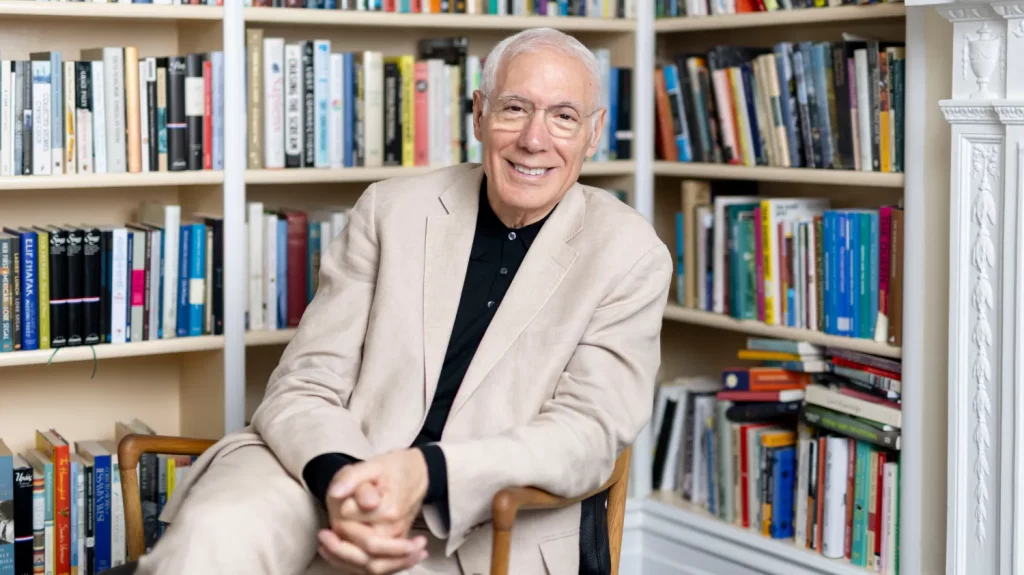
Stephen Grosz did not expect to be having this conversation. When he published The Examined Life: How We Lose and Find Ourselves in 2014 he thought it would just end up in specialist psychology bookshops. He calls it “this old thing on the shelf”. Instead the book became a Sunday Times No 1 bestseller and was translated into 30 languages. “I was really surprised,” he says.
He shouldn’t have been. Grosz’s book, a collection of stories relayed and lessons learnt after 25 years speaking to patients, scratched that most fundamental of human itches: the desire to know what is going on in other people’s heads. Since The Examined Life, psychology books have been a mainstay of the bestseller charts, spreading to television and podcasts with shows such as the BBC series Couples Therapy and the podcast Where Should We Begin? with the psychotherapist Esther Perel.
Now aged 72 and more than a decade since his debut, Grosz has written Love’s Labour, sating perhaps an even more fundamental human urge: our desire to know what is going on in other people’s bedrooms.
Love’s Labour follows a similar format to The Examined Life: a series of vignettes from his meetings with patients. A woman who loves her fiancé deeply can’t bring herself to send her half of the invitations for their wedding. A troubled young man is unable to forgive himself for the suicide of his girlfriend. A man leaves his wife for another woman and when that other woman dies he holds his ex-wife’s hand at the funeral for comfort. From these stories Grosz hopes to share “hard-won truths that my patients and I won together”.
We meet in Grosz’s treatment room on the ground floor of the beautiful terraced house in Hampstead, north London, that he shares with his wife, Nicola, an academic and translator, and his two children, a daughter, aged 22, and a 19-year-old son. “They will abide by no psychoanalysis upstairs. In fact, if one of my children has a dream they will usually turn to my wife,” he says with a laugh.
The place is a picture-perfect representation of what you imagine a psychoanalyst’s office to be: walls lined with books, a big bay window, a couch. Grosz is similarly perfectly cast: tall, with neat white hair and a calm voice, the slightest of American lilts still present from his upbringing in Indiana and university years at Berkeley, California.
“I have to sit there,” he gestures to his analyst’s chair, “otherwise this will feel odd.” If I were his analyst perhaps I’d recognise an anxiety in him — the man who asks questions now has to face questions. That’s part of the appeal of Grosz’s books: he makes you feel as if you can do this too. “This” is psychoanalysis, a therapeutic technique pioneered by Sigmund Freud that seeks to draw out the patient’s unconscious thoughts and get to the source of their distress.
A key part of this is the interpretation of dreams — something that comes up frequently in Grosz’s books. “I’m aware that most of the people who read this book will not have had analysis, so part of it was trying to convey what the experience is like,” he says.
Take the woman in Love’s Labour who visits Grosz because she is unable to send out wedding invitations. She arrives with a dream that she is uncomfortable relaying. While she is not Jewish (Grosz is), she dreamt the night before that she was herded into a changing room, promised a shower and instead found herself in a gas chamber.
The two mull over what this dream might mean. They eventually come to realise it “is not about Nazis or Jews”, Grosz says. Instead the changing room represents his office: a room where people change. The dream is a manifestation of “her anxiety about her terrible loss of her birth family if she marries her husband. She doesn’t want to give up what she has. She wants the new thing — to marry this guy — but she doesn’t want to lose her parents and she sees sending out the invitations as annihilating the family.”
“The dream is a kind of doorway in. I often see them like a movie that the patient has written, directed, produced and starred in. It’s a pure internal creation of ourselves. Today people are so focused externally that they are not thinking about their dreams, they are not thinking about their daydreams — fantasies just pass through their mind for the most part. In therapy dreams are a good way of showing a person to be more alert to their internal world and their feelings.”

Stories are sometimes dismissed as childish things. In a world driven by facts and figures – and information and money – taking the time to weave a narrative can seem trivial or off-the-point. But storytelling has a value our ancestors implicitly acknowledged.More urgently, it has a role to play in mental health, according to psychanalyst Stephen Grosz.
The author of the bestselling book The Examined Life, which has been translated into more than 30 languages, Grosz is in Dublin this week for an event hosted by the Irish Forum for Psychoanalytic Psychotherapy.
For his book, the American-born, London-based analyst weaved case histories from his professional practice into 31 individual stories. Ambiguity and wonder are shot throughout, not surprisingly as one of Grosz’s literary inspirations is Samuel Beckett. “What I like about short stories is often the endings are a bit open, like real life. That’s how a [therapy] session is: often people finish and you don’t know what’s going to happen later on.”
Part of his motivation for writing the book “was to help people who might not have had that experience” of conversation with a therapist, “to get a sense of what happens”. He explains further as this week’s Unthinkable guest.
How important is storytelling in therapy?
“To me storytelling is the way we convey our experience from one person to another. We tell each other stories to convey what we have felt and experienced.
“This was a bit of a surprise originally to Freud… There is a wonderful phrase when he looks at his [first] book and says these case histories are basically a series of stories and, he says, ‘I fear these lack the serious stamp of science’. But he was smart enough to know that it was the best way to tell what was going on.”
Does it matter if the story being told is true?
“Often people are trying to tell the truth. I say in my book that sometimes we don’t tell our story, our story tells us − in our symptoms, in our behaviours, it gives away who we are. My job is to kind of read that story, through sometimes not the verbal story a patient tells but, through their difficulties whether it’s alcoholism, or compulsive behaviour… or the problems they want help with.
“Sometimes stories function in another way. There is a thing that can happen where a patient tells you something that seems quite ordinary but the atmosphere in the room is quite powerful. It’s quite different to the story they told; it’s more than the story they told.
“It may seem like a small thing but it leaves you with a feeling, and I sometimes think it’s the feeling you would have if you’d heard the story the patient can’t tell. We have to try to listen to that story as well.
“The crucial thing is that often we, analysts, are wanting to make our discipline more scientific and we are kind of embarrassed by the fact that stories are at the heart of things. But for me, stories are the shortest distance between two people. They are the way we interact at our closest and most intimate so, in fact, it would be at the heart of analysis… We shouldn’t be embarrassed by it.”
You’ve a deep interest in philosophy, and there is a view that much of our anxiety today stems from a lack of meaning. From your experience of over 50,000 hours of conversations with clients, are people agonising over the meaning of life?
“I think they are but not consciously. It helps sometimes to start realising that there is a kind of arc of life, that there are certain things going on. So, for example, I believe part of what makes change in psychotherapy difficult is loss. To change anything you’re going to have to endure a loss.
“I quote a patient of mine who says ‘I want to change but not if it means changing’, meaning ‘I don’t do loss. Can we do this but without any loss involved?’ And that’s not possible.
“In a way, I think from the minute we are born there is loss. We lose the womb, then we have to give up the breast to have solid food, then we go to nursery and have to give up the comfort of the home, then at 18 or whatever we have to go to university, or leave the home, or go off to work.
“If you get married or get into a relationship with someone you are going to have to let go of your birth family, and people are often surprised – they will come to me at a moment like that in their life because they are depressed. It should be the happiest day of their life because ‘I’m getting married, I’m looking forward to it, I love this person, what is going on?’ They are unexpectedly caught out.
“In a way, you would say their philosophy of life is not right because it’s about happiness; they [think they] should always be happy… They don’t realise certain things like loss are built into life.”
Is anxiety on the rise and, if so, what’s driving it?
“It’s hard to know but I do think that’s true. It seems me things are more irrational at times; you know Putin threatening to use nuclear weapons… If I died in 1989 when the Berlin Wall came down you would have thought the world was going in a completely different direction than it seems to be going for the past 10 years.
“Also I do think, with things like Twitter and the internet, there is a kind of shift where things are more like a game, where numbers matter – the number of likes or retweets…
“We are playing a game against each other where we are trying to get better numbers and when you do that something is dropping out about human contact… Getting on with our neighbours, getting to know them, talking to them – the less we do that and the more we are on our phones I think is part of a general increase in anxiety.”
A point you make in the book is that we are too quick to praise our children. With your own kids, how firm a line do you take on that?
“Oh, I do praise them. The thing I was really opposed to was empty praise. I grew up in a generation where we were criticised all the time… What surprised me in the current generation was almost the mirror of that. You couldn’t move without hearing a child being told that was ‘the most beautiful’ or ‘the most wonderful’ [thing they did], and in a funny way they are both the same as neither is properly engaging with the child.
“I tell the story: my parents were good friends with the Stiglitz family – their son Joey, Joseph, won the Nobel Prize for Economics. His mum – she was a nursery teacher – was my mum’s best friend and I remember watching her with two young boys not praising but totally engaged in what they were painting, the colours, why they were choosing this; she just talked to them about what they were doing.
“What you see with a lot of parents is they are struggling to talk to their children in an ordinary way. I think it’s really good to just say: ‘Oh, tell me about that. How did you feel about that, and what did you think?’ That’s important.”
Staying in the present seems to be part of the challenge. It is hard to be present.
“It is. There is a lot now about being in the present. I think it’s important [but] the crucial thing is more knowing ourselves, accepting ourselves, seeing who we are… We can be depressed if we’re always having ‘shoulds’ – like, ‘We should be present. We should be this or that’… The tyranny of shoulds can drive depression.
“I’m inclined to think we should be more accepting of ourselves and ask if we are not in the present then why not? ‘It is upsetting being in the present’ is what I’m hearing.”
What is your greatest regret?
Hamm in Beckett’s Endgame replies: “I was never there… Absent, always.”
Interview by Joe Humphreys for the Irish Times
And interview with Tim Black for Spikd!

It’s getting late. Outside, the glare of the winter sun has given way to the airless purple of a cold January evening. A patient is due any moment now. But, as my interviewee makes profoundly clear, there really is no time like the present. So I ask one more question: ‘How much of Sigmund Freud’s thought is still vital to psychoanalysis today?’
‘That’s a very big question because there’s so much…’ Stephen Grosz pauses. Seated in his consultation room, opposite the proverbial couch, or, in this case, a bed, a testament to the imperatives of the talking cure, and speaking thoughtfully, quietly, he is clearly an heir of Freud. He tells me of his first encounter with The Interpretation of Dreams, as a 16-year-old, when his older brother, then a student at Berkeley, gave him a copy to read. And he talks of how exciting it was, in those intellectually heady years in the Sixties and Seventies, when as a Berkeley student himself, his interest in psychoanalysis intensified as his engagement in radical politics grew.
‘We all read Herbert Marcuse’s One Dimensional Man, which was drenched in Freudian thought. And Norman O Brown was at Berkeley and Santa Cruz at this point, too… Everything was political in those days’, he says, chuckling. ‘It was in Marcuse, in Brown, in the Frankfurt School in general, which I was intellectually very close to. At Berkeley, remember, the head of the sociology department was Leo Lowenthal, a friend and colleague of Theodor Adorno and Max Horkheimer. There was a great linking together of psychoanalytic ideas and political ideas, and this was happening against the background of the anti-war movement, People’s Park, the Free Speech Movement. It was an incredibly exciting time to be a 17, 18-year-old.’
And yet, for those who know Grosz from his intensely moving, almost parabolic work, The Examined Life, a presentation and interpretation of some of his most resonant case work over three decades, Freud is noticeable by his absence. There is little talk of sexuality or libido and nothing of the Oedipal complex, or its heir, the superego. The Examined Life, open-ended, ironising, wise, is closer to Chekhov than to what is popularly thought of as psychoanalysis. So is the founder of this most theoretical of psychotherapies, the explorer of the continent of the unconscious, no longer relevant?
‘One’s not looking to apply Freudian ideas to patients’, Grosz answers. ‘For a start, there’s been so much theoretical development since then, so many great clinicians and analysts, and we’ve learned a lot clinically since Freud, so we wouldn’t do some of the things that he did.’ He pauses again. ‘But I think some of Freud’s classic ideas of just listening, listening to the words of the patients, their stories. Trying to understand, for example, how their anxieties are driving their actions, how their fears are constructing these defences – these fundamental ideas, which inform my work, are there in Freud.’
‘What I tried to do in The Examined Life‘, he continues, ‘is to give a picture of the way in which those ideas are in use now, but doing so without all of the Freudian language. A historian once said it wasn’t ignorance that prevented the discovery that the world was round; it was the knowledge that the world was flat. And that’s been a problem with Freudian terminology – it has become a way of knowing things that stops us learning, a language that got in the way of seeing the patient. Psychoanalysis is a process of not knowing together, and starting to learn things.’
And that’s what The Examined Life exemplifies: not an ossified theory, heavy with jargon, but a method, a way of seeing individuals, of listening and interpreting and, alongside the patients – ‘It’s an honour to be brought into people’s lives in the way that the analyst is’, says Grosz – telling the stories that need to be told. It makes for a deeply affecting experience. There’s the anxious and depressed Rebecca, worried about her relationship, but who comes to realise that, at root, she misses her no-longer-infant son needing her; there’s lovesick Helen, whose forlorn affair with a married man, who continually breaks his word, has turned into a means to keep herself from the tumult and promise of the here-and-now; and there’s the immeasurably sad tale of nine-year-old Thomas, a disturbed, troubled, academically challenged boy, who racially abuses and even spits at Grosz as a way to provoke the angry response he needs, because it means Grosz (or the boy’s parents, or teachers) thinks he can be better than he ever really can. ‘My brain is broken’, the child admits.
Grosz’s patients are not all suffering some childhood, parent-related trauma, as psychoanalytic caricature would have it. But they are all haunted, yes, often by something obscured, painful or troubling in their past, but sometimes by a future they fear losing — the marriage and the children. They are selves haunted by loss, and by the prospect of loss, and an inability to accept, and to face up to, the necessity of change. And so they are stuck, living now, but haunted and troubled by the no longer or the not yet.
Haunting is central. ‘One story in The Examined Life is ostensibly about lovesickness, but it’s really about Charles Dickens’s A Christmas Carol‘, says Grosz. ‘I’d always loved that tale. But one day I realised something: it’s actually a profound story about psychological change. Scrooge begins as a mean miser – even the word “Scrooge” is nasty, an amalgamation of “screw” and “gouge”. But he goes from being embittered and aggrieved to being generous and kind. “He was as good a man as the city had ever seen”, as Dickens puts it. And that transformation takes place through a series of hauntings.
‘I often feel the analyst is the ghost, and you have to haunt your patient with what has happened, you have to haunt them in the present about how they are living now, and you haunt them with the future, about how life is going to be. This idea of haunting is very different to scaring someone. Scaring is the public-health warning, the picture of throat cancer on a cigarette packet, the declaration that you will die if you keep smoking. No one really changes through being scared in this way. Haunting is different. It is about seeing your own life in a very specific way, how you came to be the person you are, and how you are living in the present, and how you will continue being that person in the future, and the effect of that is quite powerful. Analysts have to be ghosts – we have to haunt our patients.’
And in the haunting, the individual faces up to his or her self, confronts loss, in near enough full consciousness. ‘One of the things that struck me while reading A Christmas Carol, was that every evening Scrooge reads his ledger’, explains Grosz. ‘What he’s doing is reassuring himself, through his miserliness, that there’s always an increase, albeit in profit – that there’s always a gain and never a loss. If you read the story carefully, you’ll see that he has lost so much – he’s lost his mother, his sister. You can feel that he’s suffered so much loss. So he’s not going to get attached to anyone. He’s not going to get married. Because he doesn’t want anyone to matter to him, and endure the pain of loss. So his only attachment is to a bank account, where profit is accruing.’
The hauntings bring Scrooge to a the point of self-recognition, of acceptance. So is this what the psychoanalyst tries to do — to bring the patient to a moment of self-clarity?
‘They achieve that themselves’, says Grosz. ‘They’re struggling to understand, and I just have some tools, which I’ve picked up in my nearly 30 years of working with people. Psychoanalysis gives individuals the space and the time to ask the questions – what was it about my relationship with my father that stopped me mourning his death? Why do I feel the way that I feel about my own child? They can then be more honest with themselves in analysis about what they’re thinking and feeling. And that I believe is invaluable – to arrive at a truthful view of oneself and the world.’
It is, of course. But not all of us require analysis to arrive at that moment of self clarity. We might all be haunted to some extent, our memories, our fears and anxieties, sometimes distorted, erupting into our present lives, but we don’t necessarily need analysis. We’re not paralysed by our spectres. When, I wonder, does this unconscious self-haunting become a problem? His answer hinges on the extent to which the haunting arrests one’s development.
‘As I get older – I’m more in the third act than the first or second – I see ever more clearly when someone is stuck developmentally. By which I mean, for instance, a 30-year-old who can’t leave their parents, for instance, who, in analysis, can’t stop talking about his parents. I’m not hearing much about his work, or friends or relationships. So I would wonder why he is afraid of letting go of his parents, because it’s only by letting go that they will make space for the next phase.
‘I don’t really say this in the The Examined Life, but it’s a subtext: life is a series of necessary losses. We’re born. We lose the womb. And we do so to gain the world. We have to go from having the umbilical cord, to having the breast, to eating solid food, to going to nursery, and then to school. And one is spending more and more time with friends and cultivating relationships outside the family. Each stage is a loss, but it is necessarily so, to make room for the new. We leave the parental home, go to college, out to work, form our own relationships, have own children and so on.
‘To have all these new things, we have to give up the old things. And I always see people stuck at various moments developmentally. So part of my work is thinking why and how I can help individuals to be freer, to live more fully.’
I’m reminded of the old Freudian battlecry, ‘Wo Es war, soll Ich werden‘ (literally, ‘where It was, there I should be’, or more figuratively, ‘Where Id was, Ego shall be’). The process, that is, where an individual brings to consciousness a hitherto unconscious, possibly repressed determinant, a process of self mastery. One’s development, one’s change, with all the loss and sometimes pain that entails, is accepted, embraced even. I suggest to Grosz that he is helping people become more autonomous.
‘You see it all the time’, Grosz explains. ‘People will be getting closer and closer to each other in a relationship, but then freezing the relationship at a certain point. They don’t get as close as they might, for various reasons. Part of my task is to understand what’s inhibiting them, what’s stopping them from becoming more devoted to their work, more devoted to their partner, to their children, to their friends – what’s preventing them from letting things matter. So they can say, “I lived the fullest life I possibly could”.’
In some ways, despite his general area of work, Grosz is offering a counterpoint to what is often characterised as therapy culture. He is not encouraging individuals to develop a relationship of psychological dependency – he’s certainly not in the business of offering the fragile self endless affirmation or esteem-raising praise, let alone antidepressant medication. Rather, he is helping to cultivate higher degrees of autonomy, helping people to live, work and forge relationships in the here and now. And crucial to that is realism, a demand that individuals confront and accept ‘the necessary series of losses’ that their development entails. Because with that acceptance of change, individuals can embrace the gains that these losses can bring, the chief one being the opportunity of the present. There is nothing easy or painless about this. As Lionel Trilling noted of Freud, an almost tragic weight is given to existence – a metaphor which echoes in Grosz’s own refrain, ‘letting things matter’.
He writes, for instance, of the kind of advice he’d want his daughter to hear should she find herself in a relationship she doesn’t want to be in, but can’t quite give up on the idea of. ‘I’d want her to be told that sometimes we have to mourn the future, that many young couples have more future than present. Breaking up means giving up not on their present, but the future they’d dreamed of. Leaving a relationship, starting a new life, meeting the right person, getting married and having a child can take a long time – much longer than she might imagine. She might have to go through some pain to have what she wants. But facing up to reality, however dreadful, is almost always better than the alternative.’
Time’s up. The buzzer goes. A patient is helped in by someone, probably a friend or a relative. Another listening is about to begin.
As I’m leaving, Grosz mentions his debt to Walter Benjamin’s The Storyteller. There Benjamin contrasted the oral tradition of storytelling, in which members of a community listened to, integrated and retold folk tales, creating wisdom from collective experience, with an atomised modernity, writ large in the individualistic world of the novel, and the incommunicable, meaning-less nature of information. Benjamin writes, ‘An orientation toward practical interests is characteristic of many born storytellers’. He mentions stories that gave peasants agricultural advice. ‘All this points to the nature of every real story. It contains, openly or covertly, something useful. The usefulness may, in one case, consist in a moral; in another, in some practical advice; in a third, in a proverb or maxim.’ Reading The Examined Life, one can’t help but notice the way in which patients’ everyday experience is, through its (re)telling, turned into stories, complete with maxims, practical advice, near proverbs – for instance, ‘paranoid fantasies are often a response to the world’s disregard. The paranoid knows that someone is thinking about him.’ ‘In every case the storyteller is a man who has counsel for his readers’, said Benjamin. The same might be said for Grosz the psychoanalyst.

It’s getting late. Outside, the glare of the winter sun has given way to the airless purple of a cold January evening. A patient is due any moment now. But, as my interviewee makes profoundly clear, there really is no time like the present. So I ask one more question: ‘How much of Sigmund Freud’s thought is still vital to psychoanalysis today?’
‘That’s a very big question because there’s so much…’ Stephen Grosz pauses. Seated in his consultation room, opposite the proverbial couch, or, in this case, a bed, a testament to the imperatives of the talking cure, and speaking thoughtfully, quietly, he is clearly an heir of Freud. He tells me of his first encounter with The Interpretation of Dreams, as a 16-year-old, when his older brother, then a student at Berkeley, gave him a copy to read. And he talks of how exciting it was, in those intellectually heady years in the Sixties and Seventies, when as a Berkeley student himself, his interest in psychoanalysis intensified as his engagement in radical politics grew.
‘We all read Herbert Marcuse’s One Dimensional Man, which was drenched in Freudian thought. And Norman O Brown was at Berkeley and Santa Cruz at this point, too… Everything was political in those days’, he says, chuckling. ‘It was in Marcuse, in Brown, in the Frankfurt School in general, which I was intellectually very close to. At Berkeley, remember, the head of the sociology department was Leo Lowenthal, a friend and colleague of Theodor Adorno and Max Horkheimer. There was a great linking together of psychoanalytic ideas and political ideas, and this was happening against the background of the anti-war movement, People’s Park, the Free Speech Movement. It was an incredibly exciting time to be a 17, 18-year-old.’
And yet, for those who know Grosz from his intensely moving, almost parabolic work, The Examined Life, a presentation and interpretation of some of his most resonant case work over three decades, Freud is noticeable by his absence. There is little talk of sexuality or libido and nothing of the Oedipal complex, or its heir, the superego. The Examined Life, open-ended, ironising, wise, is closer to Chekhov than to what is popularly thought of as psychoanalysis. So is the founder of this most theoretical of psychotherapies, the explorer of the continent of the unconscious, no longer relevant?
‘I think some of Freud’s classic ideas of just listening, listening to the words of the patients, their stories, remain vital’
‘One’s not looking to apply Freudian ideas to patients’, Grosz answers. ‘For a start, there’s been so much theoretical development since then, so many great clinicians and analysts, and we’ve learned a lot clinically since Freud, so we wouldn’t do some of the things that he did.’ He pauses again. ‘But I think some of Freud’s classic ideas of just listening, listening to the words of the patients, their stories. Trying to understand, for example, how their anxieties are driving their actions, how their fears are constructing these defences – these fundamental ideas, which inform my work, are there in Freud.’
‘What I tried to do in The Examined Life’, he continues, ‘is to give a picture of the way in which those ideas are in use now, but doing so without all of the Freudian language. A historian once said it wasn’t ignorance that prevented the discovery that the world was round; it was the knowledge that the world was flat. And that’s been a problem with Freudian terminology – it has become a way of knowing things that stops us learning, a language that got in the way of seeing the patient. Psychoanalysis is a process of not knowing together, and starting to learn things.’
And that’s what The Examined Life exemplifies: not an ossified theory, heavy with jargon, but a method, a way of seeing individuals, of listening and interpreting and, alongside the patients – ‘It’s an honour to be brought into people’s lives in the way that the analyst is’, says Grosz – telling the stories that need to be told. It makes for a deeply affecting experience. There’s the anxious and depressed Rebecca, worried about her relationship, but who comes to realise that, at root, she misses her no-longer-infant son needing her; there’s lovesick Helen, whose forlorn affair with a married man, who continually breaks his word, has turned into a means to keep herself from the tumult and promise of the here-and-now; and there’s the immeasurably sad tale of nine-year-old Thomas, a disturbed, troubled, academically challenged boy, who racially abuses and even spits at Grosz as a way to provoke the angry response he needs, because it means Grosz (or the boy’s parents, or teachers) thinks he can be better than he ever really can. ‘My brain is broken’, the child admits.
Grosz’s patients are not all suffering some childhood, parent-related trauma, as psychoanalytic caricature would have it. But they are all haunted, yes, often by something obscured, painful or troubling in their past, but sometimes by a future they fear losing — the marriage and the children. They are selves haunted by loss, and by the prospect of loss, and an inability to accept, and to face up to, the necessity of change. And so they are stuck, living now, but haunted and troubled by the no longer or the not yet. (read the full interview)